Many of you know that I’m an art lover. Being married to an art historian that should not come as a surprise. He learned me a lot but over the years on top of that I have been reading a lot on the topic myself.
The artist James Barnos has often reminded me that there is an African proverb which says that a society flourishes if its people plant trees whose shade they won’t live enough to enjoy, but which will perhaps benefit future generations. This idea of a system with a longer time span is fundamental today for art in all its forms: we have to move beyond short-term thinking. We must think of objects that will last, contrary to the idea of fast fashion and design. It is a formidable challenge for architecture as well.
by Hans Ulrich Obrist
I love art but I also want to understand the business of art. Some gallery owners have become friends, and through informal conversations I try to see how it works: what is their (business) plan, how do they select artists, how do hey split any profit or loss, … ? What is clear to me is that the one thing they all have in common is that they are passionate about their business.
At home we have a lot of art books, but I also read (and collect) books about all aspects of art management. By Magnus Resch “How to collect art”, “Management of Art Galleries” and “How to Become a Succesful Artist”. Or “Confessions of a Poor Collector” by Eugene M. Schwarz, “The Story of Art Without Men” by Katy Hessel, “Ways of Seeing” by John Berger, … You can check my list on Goodreads.
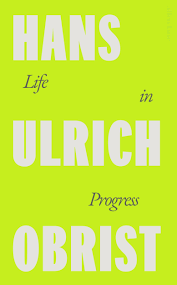
I’m now reading “The Curator’s Handbook” by Adrian George, 374 pages (small typo) with all the ins and outs of curating an exhibition. The book goes very much into details but it’s interesting. A lot of it actually applies to other industries as well. In paralel I read “Life in Progress” by Hans Ulrich Obrist, a Swiss curator, who now works as the Director of the Serpentine Galleries in London. A personality!

The question of rituals is important to me. As the philosopher Byung-Chul Han put it, rituals create a community without communication, whereas these days we predominantly have communication without community. I think this is a key phrase, and we must today think afresh about what might connect human beings in a polarised world. What do we need to encourage different points of view to join together and act in unison? How do we make the hardware and the software that will connect humans in a divided world? Because at present technology polarises and divides more than it connects.
by Hans Ulrich Obrits
To conclude, I sometimes wonder if I have to steer my passion for art into a different direction? Start a gallery? Curate an exhibition? Write about art? … But then, who am I … ?
I have always stimulated people around me to colour outside of the box. So why shouldn’t I be doing this myself? Apply what you preach, not?
Adrien George, “The Curator’s Handbook”, Thames & Hudson.
Hans Ulrich Obrist, “Life in Progress”, Allen Lane, Penguin Books.
 JEAN PHILIP DE TENDER
Plaats een reactie